
You’re planning to build your home. You’ve got the plot, the design, and the building approval. Now comes the big question that almost every builder in Trichy faces:
“Should I go for a full contractor who handles everything — or should I buy materials myself and just hire labour?”
This is the Labour Contract vs Full Contract decision. And it’s one of the most important choices you’ll make in your entire construction journey.
This guide explains everything — what a labour contract is, how it works, what it costs, what the contract should contain, and who it’s really suitable for. Let’s break it all down.
What Is a Labour Contract?
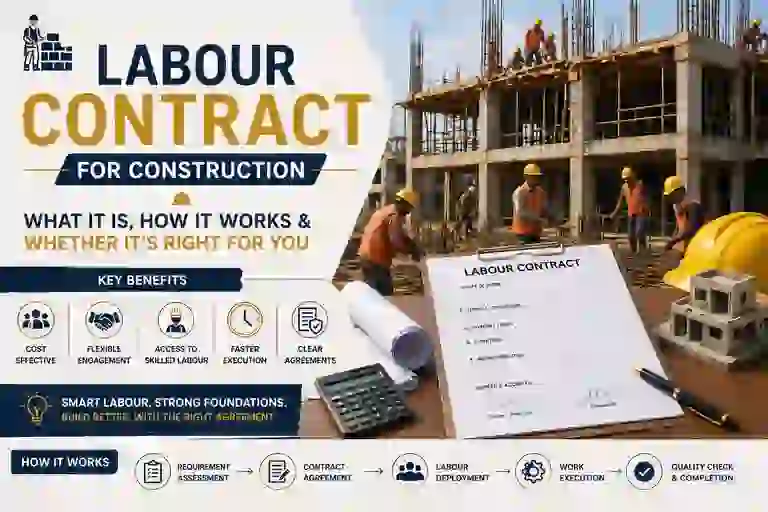
A labour contract (also called a labour rate contract or labour-only contract) is an arrangement where:
- You, the owner, purchase all construction materials — cement, steel, bricks, sand, tiles, paint, everything
- The contractor provides only the workforce — masons, helpers, carpenters, plumbers, electricians, and supervisors — and charges you for their labour
In simple terms: you buy the materials, they do the work.
This is different from a full contract (also called a material contract or turnkey contract) where the contractor handles both materials and labour for a fixed per-square-foot rate.
Labour Contract vs Full Contract — Which One Is Better?
This is the real question. Here’s an honest comparison:
| Factor | Labour Contract | Full Contract |
|---|---|---|
| Who buys materials | You (the owner) | Contractor |
| Cost control | Higher — you choose every material | Lower — contractor decides unless you specify |
| Potential savings | 7–15% savings possible | Slightly higher cost but hassle-free |
| Your involvement | Very high — daily supervision needed | Minimal — contractor manages everything |
| Risk of material fraud | Low — you buy directly | Higher — contractor may substitute cheaper materials |
| Accountability | Harder to blame contractor for material issues | Clear single-point accountability |
| Suitable for | Experienced owners with time to supervise | Busy owners, NRIs, first-time builders |
| Best when | You have strong market knowledge | You trust your contractor completely |
The Honest Truth
Labour contract can save you money — but only if you know what you’re doing. If you don’t know the difference between M20 and M25 concrete, or between Fe415 and Fe500 steel, or how to negotiate with a sand supplier — you may end up paying more than a full contract while getting worse quality.
Labour contract rewards knowledge. Full contract rewards trust.
How Much Does Labour Contract Cost in Trichy?
Labour rates in Trichy are charged either per square foot (for the complete scope) or per day per worker (for specific tasks).
Labour Rate Per Square Foot (Complete Construction)
| Work Type | Labour Rate Per Sq. Ft |
|---|---|
| Basic structure only (foundation to roof slab) | ₹300 – ₹450 |
| Structure + brickwork + plastering | ₹450 – ₹550 |
| Complete construction (all civil work) | ₹850 – ₹1000 |
| Interlocking / special brickwork | ₹450 – ₹500 |
💡 These are labour-only rates — materials are over and above this.
Daily Labour Rates in Trichy (Per Worker Per Day)
| Worker Type | Daily Rate (Approx.) |
|---|---|
| Mason (experienced) | ₹900 – ₹1,300 |
| Helper / unskilled labourer | ₹450 – ₹750 |
| Carpenter | ₹900 – ₹1,200 |
| Bar bender (steel fixer) | ₹900 – ₹1,250 |
| Plumber | ₹750 – ₹900 |
| Electrician | ₹750 – ₹900 |
| Painter | ₹700 – ₹950 |
| Tile layer | ₹800 – ₹1,200 |
| Supervisor / foreman | ₹1,200 – ₹1,800 |
💡 Labour contractor rates in Trichy typically range from ₹500 to ₹1,500 per day per worker depending on skill level.
Full Project Labour Cost Example
Say you’re building a 1,200 sq. ft house in Trichy with a labour-only contract at ₹900 per sq. ft:
- Labour cost: ₹10 Lakhs
- Material cost (owner purchases): ₹18–22 Lakhs (depending on grade)
- Total project cost: ₹28–32 Lakhs
Compare this to a full contract at ₹2,400 per sq. ft:
- Total cost: ₹28.8 Lakhs
The difference may or may not be significant — but with a labour contract, you control exactly what materials go into your home.
What Does a Labour Contract Agreement Include?
This is where most people go wrong — they agree verbally on a rate and start work without a proper written contract. This is a recipe for disaster.
A proper Labour Contract Agreement must include:
1. 📋 Details of Both Parties
- Full name, address, and contact of the owner
- Full name, address, contact, and ID proof of the labour contractor
- Date of agreement
2. 🏗️ Scope of Work
Exactly what work the contractor is responsible for — very clearly listed. For example:
- Excavation and earthwork
- Foundation and plinth filling
- Column, beam, and slab concrete work
- Brick / block laying
- Internal and external plastering
- Flooring tile laying
- Door and window frame fixing
- Plumbing rough-in and finishing
- Electrical conduit laying and wiring
- Painting
Each item must be listed separately. “All civil work” is not specific enough and leads to disputes.
3. 📐 Technical Specifications
This is critical. The agreement must specify:
- Concrete mix ratios (e.g., M20 for slabs, M15 for footings)
- Minimum curing period (21 days for slabs)
- Brick laying pattern (English bond / Flemish bond)
- Plaster thickness (12mm internal, 20mm external)
- Tile fixing method (full bedding vs spot fixing)
- Electrical wire sizes (4 sq. mm for power, 2.5 sq. mm for lights)
4. 💰 Payment Terms
Clearly state:
- The agreed rate (per sq. ft or lump sum)
- Payment schedule — milestone-based (never pay 100% upfront)
- Mode of payment (cheque or bank transfer recommended — avoid full cash)
- Retention amount — typically 5–10% held back until all snags are fixed
A typical milestone-based payment schedule:
| Milestone | Payment % |
|---|---|
| Agreement signing (advance) | 10% |
| Foundation completion | 15% |
| Ground floor slab completion | 20% |
| First floor / roof slab completion | 20% |
| Brickwork and plastering completion | 20% |
| Finishing work completion | 10% |
| Final handover (after snag fixing) | 5% |
5. 📅 Timeline & Completion Date
- Start date and expected completion date
- Milestone-wise completion dates
- Penalty clause for delays beyond agreed dates — typically ₹500–₹2,000 per day of delay
6. 👷 Worker Responsibilities
- Contractor is responsible for bringing adequate workers daily
- Contractor manages worker attendance, wages, and disputes
- Contractor is responsible for any damage caused by their workers
- Owner provides water, electricity, and basic storage at site
7. 🦺 Safety & Legal Compliance
- Contractor must follow site safety rules — helmets, harnesses at height
- Contractor is responsible for worker insurance under the Workmen’s Compensation Act
- Contractor must comply with Contract Labour (Regulation and Abolition) Act, 1970
- Any accidents on site — contractor’s liability must be clearly defined
8. 🔧 Defect Liability Period
- A minimum 12-month defect liability period after completion
- Any defects in workmanship during this period must be rectified by the contractor at no additional cost
- Material defects are owner’s responsibility — workmanship defects are contractor’s
9. ⚖️ Dispute Resolution
- How disputes will be resolved — negotiation first, then arbitration
- Which court has jurisdiction — typically the local court in Trichy
What Materials Does the Owner Need to Buy?
Under a labour contract, you buy everything. Here’s a complete list of materials you’ll need to procure and manage:
Structural Materials
- Cement (OPC 53 grade — ACC, UltraTech, Dalmia)
- TMT Steel bars (Fe500D — TATA, JSW, SAIL)
- River sand / M-sand
- Blue metal / aggregate (20mm and 12mm)
- Bricks / AAC blocks
Masonry & Finishing
- Binding wire
- Nails, bolts, anchors
- Tiles (floor, wall, parking)
- Tile adhesive and grout
- Plaster of Paris / putty
- Paint (primer, interior, exterior)
Doors & Windows
- Door frames and shutters
- Window frames (UPVC or wood)
- Door hardware (hinges, locks, handles)
- Grills and safety bars
Plumbing Materials
- PVC / CPVC pipes and fittings
- Bathroom fittings (EWC, wash basin, taps, shower)
- Water sump materials
- Overhead tank
Electrical Materials
- Electrical wires (ISI marked)
- Conduit pipes and boxes
- Switches and sockets (Legrand, Havells, Anchor)
- MCB and distribution board
- Light fixtures and fans
💡 Managing all of this requires significant time, market knowledge, and constant attention. This is the primary reason most first-time builders prefer a full contract.
Responsibilities — Owner vs Labour Contractor
Here’s a clear breakdown of who is responsible for what:
| Responsibility | Owner | Labour Contractor |
|---|---|---|
| Buying materials | ✅ | ❌ |
| Storing materials at site | ✅ | ❌ |
| Site access, water, electricity | ✅ | ❌ |
| Providing design drawings | ✅ | ❌ |
| Bringing workers daily | ❌ | ✅ |
| Worker wages and management | ❌ | ✅ |
| Workmanship quality | ❌ | ✅ |
| Construction tools and equipment | ❌ | ✅ |
| Worker safety and insurance | ❌ | ✅ |
| Rectifying workmanship defects | ❌ | ✅ |
| Daily site supervision | Both | Both |
The Labour Contract Process — Step by Step
Step 1 — Get Your Design Ready
Before approaching any contractor, have your approved building plan and detailed drawings ready. A contractor needs drawings to quote accurately.
Step 2 — Get Multiple Quotes
Approach at least 3–4 labour contractors and get quotes in writing. The quote should clearly mention the rate per sq. ft and exactly what scope of work it covers.
Step 3 — Verify the Contractor
- Ask for references from at least 2–3 completed projects in Trichy
- Visit those sites or speak to those owners
- Check if the contractor has a stable, reliable team — not ad-hoc daily hirings
Step 4 — Draft a Proper Agreement
Never start work on a verbal agreement or a WhatsApp message. Get a proper written contract drafted — covering all the elements mentioned above. Have it signed by both parties on stamp paper.
Step 5 — Arrange Material Supply Chain
Before work begins, establish your material suppliers — cement dealer, steel dealer, sand supplier, brick supplier. Agree on credit terms and delivery schedules. Running out of materials mid-pour is a serious problem.
Step 6 — Start Construction with Daily Oversight
With a labour contract, someone knowledgeable must visit the site every single day — you, a family member, a hired site supervisor, or a PMC consultant. Without daily supervision, quality slips and materials walk off the site.
Step 7 — Milestone Payments
Release payments only when milestones are genuinely complete and verified. Keep 5–10% as retention until all defects are fixed after completion.
When Labour Contract Makes Sense — And When It Doesn’t
✅ Labour Contract Is Right for You If:
- You have strong knowledge of construction materials and processes
- You have time to visit the site daily or have a trusted person to do so
- You have established relationships with reliable material suppliers in Trichy
- You’re building a second home and learned from your first experience
- You want full control over every material that goes into your building
❌ Labour Contract Is NOT Right for You If:
- You’re a first-time builder with no construction background
- You have a full-time job and cannot supervise daily
- You’re an NRI or outstation owner who can’t visit regularly
- You don’t have existing relationships with material suppliers
- You don’t have time to manage deliveries, shortages, and quality checks
5 Common Labour Contract Problems in Trichy — And How to Avoid Them
1. Contractor brings fewer workers than agreed
Avoid it: Include a minimum daily worker count in your contract and a penalty for non-compliance.
2. Work stops suddenly for no clear reason
Avoid it: Tie payment releases strictly to milestone completion — don’t advance money beyond the current stage.
3. Material wastage or theft at site
Avoid it: Store cement and steel in a lockable area. Do daily material counts. Never leave valuable materials unattended overnight without security.
4. Poor workmanship — crooked walls, uneven plaster
Avoid it: Specify quality standards in the contract. Do stage-wise inspections and don’t approve (or pay for) the next stage until the current one meets standards.
5. Disputes over scope — “that work wasn’t included”
Avoid it: Write the scope in extreme detail. If it’s not written, assume it’s disputed.
Frequently Asked Questions
Q: Can I hire different contractors for different trades — one for structure, another for plumbing, another for electrical?
Yes — this is called a multi-trade labour contract approach. It gives you more control and sometimes better pricing for each trade. The downside is that you’re coordinating multiple contractors simultaneously, which requires strong site management.
Q: Is a verbal agreement legally valid in India?
Technically yes, but proving it in court is nearly impossible. Always use a written agreement on stamp paper for any contract above ₹500. For construction, always use a written contract regardless of the amount.
Q: What is the minimum advance I should give a labour contractor?
10% of the total contract value is a reasonable advance — enough to mobilise workers and tools. Never pay more than 20% upfront before work has started.
Q: Can a labour contractor subcontract the work to someone else?
Only if your agreement permits it. Include a clause stating the contractor cannot subcontract without your written approval.
Q: Does Acasa Construction offer labour-only contracts?
Yes — at Acasa Construction, we offer flexible engagement models including labour-only contracts for owners who prefer to purchase their own materials. We bring our skilled, experienced workforce to your site while you maintain full control of material procurement.
Build With Confidence — Whichever Model You Choose
Whether you go with a labour contract or a full contract — the key to a successful construction project is always the same: the right team, a proper written agreement, and quality materials.
A labour contract is powerful when used correctly. But it demands your time, knowledge, and daily attention. If you have all three — it can save you a significant amount of money while giving you complete control over your home.
At Acasa Construction, we offer both labour-only and full construction contracts — and we’ll honestly advise you which model is better suited for your specific situation, budget, and availability.
👉 Explore all our Construction Services in Trichy and find the engagement model that works best for you.
📞 Call us today for a free consultation — let’s figure out the right approach for your project.
Labour rates reflect current market conditions in Trichy, Tamil Nadu for 2025–2026. Rates may vary based on project complexity, worker availability, and market conditions.