
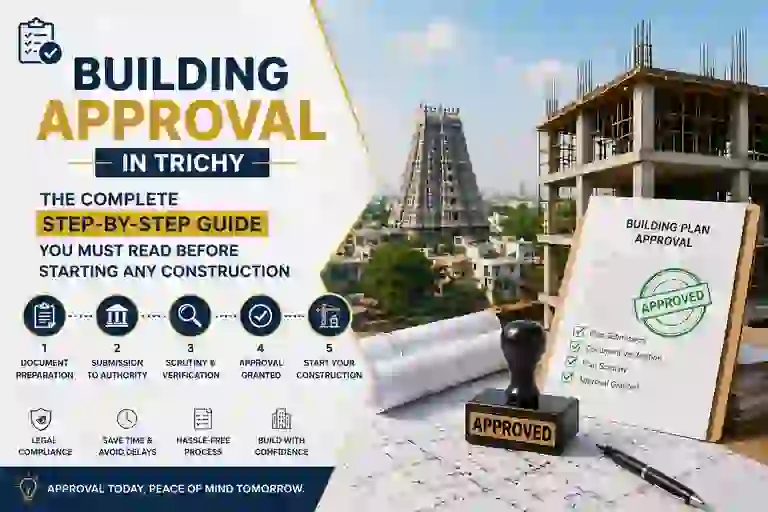
Let’s say you’ve bought a plot in Trichy. You have your house design ready. You’re excited. You just want to start building.
But here’s the truth — if you start construction without a building approval, you are breaking the law.
Your building can be demolished. You can be fined. You can face serious legal trouble when you try to sell the property years later.
Building approval isn’t just paperwork. It’s the legal permission that protects your construction, your investment, and your family’s future.
The good news? Once you understand the process, it’s not that scary. This guide will walk you through every single step — clearly, simply, and honestly.
What Is Building Approval and Why Is It Mandatory?
Building approval (also called Building Plan Sanction or Building Permit) is the official permission given by your local government authority to construct a building on your plot.
In Trichy, this is governed by:
- Tamil Nadu Town and Country Planning Act, 1971 — Section 47(A)
- Tamil Nadu Combined Development and Building Rules (TNCDRBR), 2019
These rules apply to every construction in Trichy — residential homes, commercial shops, offices, warehouses — no exceptions.
Think of building approval as your government’s way of saying — “We’ve checked your plan. It’s safe, it’s legal, and you have permission to build.”
Who Gives Building Approval in Trichy?
This depends on where your plot is located and how big your building is:
| Your Location | Authority |
|---|---|
| Inside Trichy City limits | TCMC — Tiruchirappalli City Municipal Corporation |
| Peri-urban / outskirts area | DTCP — Directorate of Town and Country Planning |
| Rural / Panchayat areas | Local Panchayat / Block Development Office |
Who Reviews Your Application Within TCMC?
- Assistant Commissioner (Zone) — for residential buildings up to 1,500 sq. ft and non-residential buildings above 100 sq. ft
- Executive Engineer (Planning Dept.) — for residential buildings above 1,500 sq. ft and larger commercial projects
What Approvals Do You Actually Need?
Building approval isn’t just one document. Depending on your project, you may need several clearances:
| Approval | What It Is | Who Needs It |
|---|---|---|
| Patta & Chitta | Proof of land ownership | Everyone |
| Land Conversion Certificate | Converts agricultural land to residential/commercial use | If your land was agricultural |
| Layout Approval | Approves the plot subdivision in a layout | If buying in a plotted layout |
| Building Plan Approval | Approves your building design | Every new construction |
| Structural Stability Certificate | Certifies structural safety | Multi-floor or large buildings |
| Water & Drainage NOC | Clearance for water/sewage connection | All buildings |
| TANGEDCO EB Connection | Electricity connection approval | All buildings |
| Fire NOC | Fire safety clearance | Apartments, high-rises, commercial |
| Completion Certificate | Confirms building is built as per approved plan | After construction is done |
| Occupancy Certificate | Permits you to move in / use the building | Before occupancy or resale |
Documents Required for Building Plan Approval
Here’s exactly what you need to gather before applying:
Mandatory Documents
- ✅ Filled application form
- ✅ Building plan drawings — 5 sets, signed by a licensed architect or engineer
- ✅ Building plan in .dxf file format (for online submission)
- ✅ Road width sketch
- ✅ Plot approval copy
- ✅ Land ownership documents (Sale Deed)
- ✅ Site photographs
- ✅ Form A, Form B, Form C (as applicable)
- ✅ Chitta (in PDF or JPEG format)
- ✅ Topo plan
- ✅ Affidavit document
- ✅ Residuary plot details
Supporting Documents (Recommended to Include)
- 📄 Patta copy
- 📄 Adangal copy
- 📄 Encumbrance Certificate (EC)
- 📄 FMB (Field Measurement Book) sketch
- 📄 Legal opinion copy
💡 Pro Tip: Missing even one document will delay your application. Get everything in order before submitting — not after.
How to Apply — Online & Offline
🖥️ Online (Recommended)
Tamil Nadu has a dedicated portal for building plan approvals:
Tamil Nadu Single Window Portal for Planning Permission
👉 onlineppa.tn.gov.in
Steps to apply online:
- Register on the portal with your mobile number and Aadhaar
- Fill in the application with your plot and building details
- Upload all required documents in the specified formats
- Pay the government fee online
- Submit and note your Application ID
- Track your application status online using the Application ID
- Receive your digitally signed Building Plan Approval Certificate upon approval
🏢 Offline
Walk into the TCMC Zonal Office for your area with:
- Completed application form
- All document sets (physical copies)
- Demand Draft / Challan for application fee
- Submit to the Assistant Commissioner for your zone
How Long Does Approval Take?
This is the question everyone asks. Here’s the honest answer:
| Project Type | Typical Processing Time |
|---|---|
| Small residential (under 1,500 sq. ft) | 3–6 weeks |
| Larger residential / multi-floor | 6–10 weeks |
| Commercial buildings | 8–14 weeks |
| Complex projects (industrial, high-rise) | 3–6 months |
Processing time depends on document completeness, the reviewing authority’s workload, and whether any NOCs from other departments are required.
Important: These are working day estimates. Incomplete applications, document rejections, or NOC delays can extend this significantly. Getting your documents right the first time is the fastest path to approval.
How Much Does Building Approval Cost in Trichy?
Government fees are calculated based on your plot size, building type, and total floor area. Here’s a general range:
| Project Type | Government Fee (Approx.) |
|---|---|
| Small residential (600–1,000 sq. ft) | ₹8,000 – ₹20,000 |
| Medium residential (1,000–2,000 sq. ft) | ₹20,000 – ₹45,000+ |
| Large residential / multi-floor | ₹45,000 – ₹1,00,000+ |
| Commercial buildings | ₹50,000 – ₹2,00,000+ |
Professional Fees (If You Hire a Consultant)
| Service | Approximate Fee |
|---|---|
| Architect / engineer drawing preparation | ₹15,000 – ₹50,000 |
| Approval consultant (end-to-end liaison) | ₹20,000 – ₹60,000 |
| Complete approval package (drawings + documentation + submission) | ₹35,000 – ₹1,00,000 |
The Complete Approval Process — A Clear Timeline
Week 1–2 — Document Preparation
Hire a licensed architect or engineer to prepare your building drawings as per TCMC/DTCP norms. Gather all land documents — Patta, Chitta, Sale Deed, EC. Get your Affidavit notarised.
Week 2–3 — Application Submission
Submit online via the Tamil Nadu PPA portal or offline at the TCMC Zonal Office. Pay the government fee. Collect your application receipt and note your Application ID.
Week 3–6 — Review by Authority
The Assistant Commissioner or Executive Engineer reviews your application. They check for compliance with TNCDRBR 2019 — setbacks, height restrictions, FAR (Floor Area Ratio), parking requirements, and fire safety provisions.
During Review — Site Inspection (if required)
For larger or commercial projects, an official may visit your site to verify the plot boundaries and road access.
Week 4–10 — NOC Collection (if required)
If your project needs fire NOC, TANGEDCO clearance, or water board NOC, these are collected in parallel. This is often what causes delays — plan for it.
Final Stage — Approval Issued
Once all checks are cleared, your Building Plan Approval Certificate is issued — digitally signed and verifiable online.
Important Rules You Must Know (TNCDRBR 2019)
These are the key regulations your building plan must follow to get approved:
Setback Requirements (Minimum distance from plot boundary)
| Plot Size | Front Setback | Side Setback | Rear Setback |
|---|---|---|---|
| Up to 100 sq. mt | 1.5 m | 1 m | 1 m |
| 100–300 sq. mt | 2 m | 1.2 m | 1.5 m |
| 300–600 sq. mt | 3 m | 1.5 m | 2 m |
| Above 600 sq. mt | 4.5 m | 2 m | 3 m |
Floor Area Ratio (FAR)
FAR determines how much total built-up area you can have relative to your plot size. In Trichy’s residential zones, FAR is typically 1.5 to 2.0 — meaning on a 1,000 sq. ft plot, you can build up to 1,500–2,000 sq. ft total across all floors.
Height Restrictions
- Ground floor only: Up to 9 metres
- Multi-floor residential: Subject to FAR and road width
- High-rise (above 15 m): Additional Fire NOC and structural clearances required
Parking Requirements
- 1 BHK: No mandatory parking
- 2 BHK and above: 1 car parking space per unit
- Commercial: Based on built-up area and type of use
What Happens After Construction? Don’t Forget These!
Getting the building plan approval is the start, not the finish. After construction, you still need:
1. Plinth Inspection
After the foundation and plinth level is complete, an inspection is done to verify the building is being constructed as per the approved plan.
2. Last Storey Inspection
When the final floor structure is complete, another inspection happens before roof finishing.
3. Completion Certificate
Once your building is fully constructed, you apply for a Completion Certificate — confirming that the building was built exactly as per the sanctioned plan.
4. Occupancy Certificate
This is your final clearance to legally occupy the building. Without this, technically you cannot move in. It’s also required for:
- Getting a bank loan against the property
- Selling the property later
- Getting a rental agreement legally registered
What If You Build Without Approval?
People ask this. Here’s the honest answer — it’s not worth the risk:
- 🚫 Legal action under Tamil Nadu Town and Country Planning Act
- 🚫 Heavy fines — calculated per sq. ft of unapproved construction
- 🚫 Demolition orders — yes, your building can be ordered to be torn down
- 🚫 No bank loan against an unapproved building
- 🚫 Difficulty selling — buyers and their banks will reject unapproved buildings
- 🚫 No legal protection if a neighbour disputes your boundary
There are regularisation schemes that come up occasionally, but they’re not guaranteed and come with heavy penalty fees. Don’t gamble your life savings on it.
Frequently Asked Questions
Q: Can I start foundation work while waiting for approval?
No. You must have the approved building plan in hand before breaking ground. Starting before approval is illegal and can lead to a stop-work notice.
Q: My neighbour built without approval and nothing happened. Why should I bother?
Because nothing has happened yet. Problems surface when they try to sell, apply for a loan, or a complaint is filed. One neighbour dispute can unravel years of illegal construction overnight.
Q: What if my approved plan changes during construction?
You need to apply for a plan amendment/revision with TCMC before making any structural changes. Deviating from the approved plan without permission can invalidate your Completion Certificate.
Q: How do I check if a plot I’m buying has approved plans?
You can verify any building plan approval on the Tamil Nadu PPA portal using the approval number. Always ask the seller for the approved plan copy and verify it online before buying.
Q: Can Acasa Construction handle the entire approval process for me?
Yes — we offer complete building approval assistance. From preparing your architectural drawings to submitting the application, following up with authorities, and getting your certificate. You don’t need to visit a single government office.
Don’t Let Paperwork Stop Your Dream
Building approval feels like a bureaucratic hurdle. And honestly? Without the right help, it can be frustrating. Wrong documents, missed forms, unclear rules — it slows people down.
But with the right partner, it’s smooth, fast, and stress-free.
At Acasa Construction, we’ve navigated TCMC approvals, DTCP clearances, Fire NOCs, and Completion Certificates for dozens of projects across Trichy. We know exactly what each authority needs, we prepare every document correctly the first time, and we keep you updated throughout.
You focus on planning your dream space. We’ll handle the paperwork.
👉 Explore all our Construction Services in Trichy to see how we support you end-to-end.
📞 Call us today for a free consultation on your building approval process.
Information based on Tamil Nadu Town and Country Planning Act 1971, TNCDRBR 2019, and current TCMC procedures. Updated for 2025–2026. Always verify current fee structures with TCMC as they are subject to revision.